
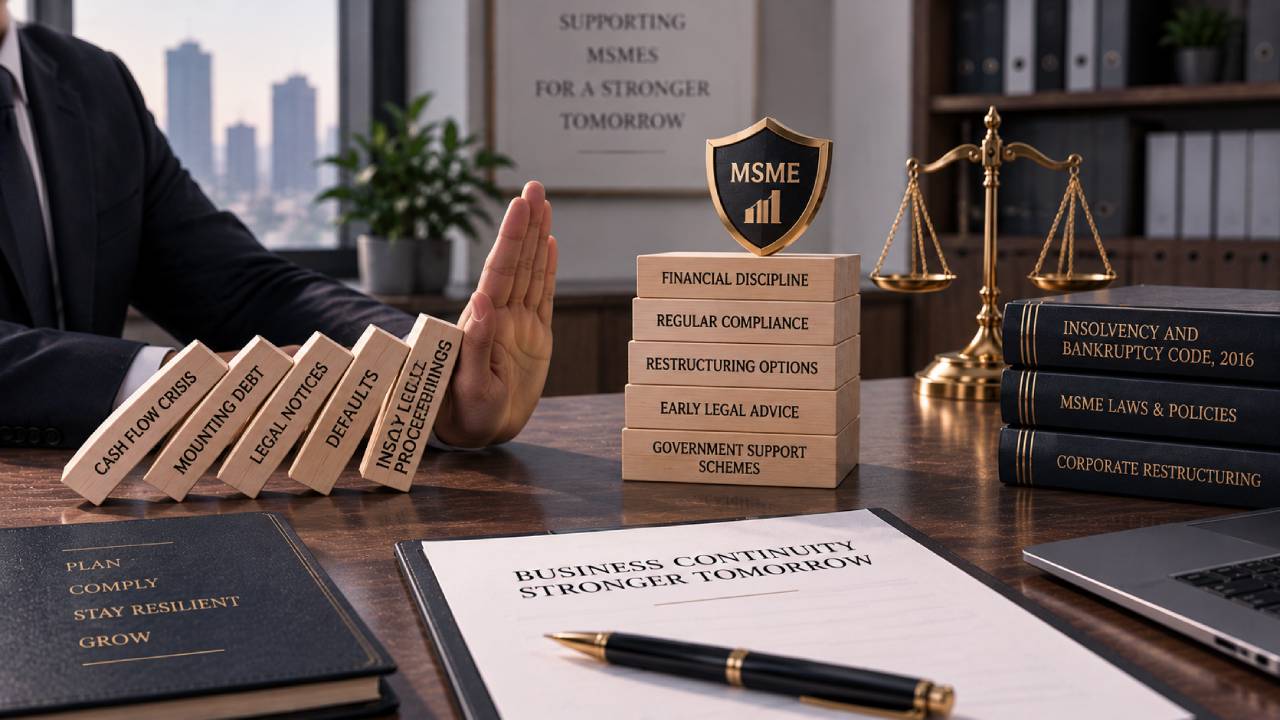
Financial stress does not always mean an MSME must enter insolvency proceedings. Early action can create opportunities to restructure debt, improve cash flow, recover outstanding receivables and negotiate with lenders before a formal insolvency application is admitted. MSME insolvency becomes a serious risk when financial distress is allowed to continue without a credible recovery plan.
For Indian businesses, the response should begin well before a petition reaches the National Company Law Tribunal. The business structure, creditor profile, Udyam status, nature of default, available security and viability of the enterprise all influence the options available.
Recognise financial distress before default becomes unmanageable
The earliest warning signs are often operational rather than legal. Repeated delays in paying suppliers, missed loan instalments, increasing use of short term borrowing, unpaid statutory dues, falling order volumes and persistent negative cash flow can indicate deeper financial stress. Management should prepare a realistic cash flow forecast rather than relying only on annual accounts. The forecast should show expected receipts, secured payments, salaries, statutory obligations, loan instalments and essential operating costs. The purpose is to identify the point at which available cash may become insufficient. Early identification gives the business more room to negotiate. Waiting until several creditors begin legal action can sharply reduce the available choices.
Confirm whether the business qualifies as an MSME
MSME status can be important when considering restructuring and insolvency options. From 1 April 2025, the Government revised the classification thresholds. A micro enterprise can have investment of up to ₹2.5 crore and turnover of up to ₹10 crore. For a small enterprise, the respective limits are ₹25 crore and ₹100 crore. A medium enterprise can have investment of up to ₹125 crore and turnover of up to ₹500 crore. The classification uses investment and turnover together.
The official Udyam Registration portal also confirms registration is online, paperless and based on self declaration. An enterprise should keep its Udyam records accurate and current. However, MSME status alone does not prevent a creditor from pursuing remedies under the Insolvency and Bankruptcy Code. A recent NCLT related decision also illustrates why the timing and validity of MSME status can matter when a company seeks the benefits available to MSMEs during insolvency proceedings.
Prepare a complete creditor position
An MSME under stress should identify every creditor before negotiating a solution. The review should distinguish banks, financial institutions, trade creditors, employees, statutory authorities, related parties and other claimants. For each creditor, management should record the principal amount, interest, security, maturity date, current arrears, guarantees and any pending legal action. Loan documents deserve particular attention. The business should determine whether a lender has rights arising from default, financial covenants, security documents or guarantees. A creditor map makes negotiations more credible. It also prevents management from overlooking liabilities which could later affect a restructuring plan.
Negotiate with lenders before the situation deteriorates
A lender is generally in a stronger position once a default has become serious and formal recovery action has begun. An MSME should therefore approach lenders with evidence rather than a general request for more time. A useful restructuring proposal can explain why the business became stressed, whether the problem is temporary or structural, how much cash the business can generate and what payment schedule it can realistically sustain.
Depending on the lender and applicable framework, possible measures can include rescheduling, restructuring, changes to repayment terms, additional working capital or other negotiated arrangements. The RBI has maintained a framework for revival and rehabilitation of MSMEs. Its framework emphasises identification of incipient stress and rehabilitation before the enterprise reaches a point of severe financial deterioration. The exact restructuring option depends on the lender, exposure, borrower category and current RBI framework. Historical pandemic relief measures should not be treated as continuing general entitlements.
Recover money owed to the MSME
Cash trapped in unpaid invoices can be one of the biggest causes of business distress. An MSME should actively pursue overdue commercial receivables rather than relying solely on new borrowing. Where the enterprise qualifies as a micro or small enterprise, the MSMED Act provides a specialised framework for delayed payments. The Micro and Small Enterprises Facilitation Council can become relevant in appropriate cases.
The Government’s MSME CHAMPIONS portal provides information concerning delayed payment disputes and the operation of the Facilitation Council framework. It also addresses the interaction between MSEFC awards and insolvency proceedings. Contract terms, purchase orders, invoices, delivery records and acknowledgement of liability should be preserved carefully. Strong documentation can improve the prospects of recovery. Recovering even a portion of substantial receivables can materially change an MSME’s liquidity position.
Consider a negotiated settlement with creditors
Not every financial problem requires a formal restructuring proceeding. A negotiated settlement may be suitable where creditors believe the business remains viable and the proposed payment plan is credible. The settlement may involve a revised payment schedule, partial settlement, interest adjustment, security enhancement or another agreed arrangement. The terms should be documented properly. Informal assurances are rarely sufficient when significant debt is involved. An MSME should also avoid promising payments beyond its realistic capacity. A failed restructuring attempt can reduce creditor confidence and leave the business with less time before formal proceedings begin.
Understand the difference between financial stress and insolvency proceedings
Financial difficulty and formal insolvency are not identical. The IBC provides a statutory process for resolving insolvency of qualifying corporate debtors. Once proceedings are admitted, the business faces a formal framework involving the insolvency professional, creditors and the adjudicating authority. The process can materially affect management control, business operations and negotiations with creditors. This is why preventive action matters. An MSME may have greater flexibility before a formal insolvency process begins. The Government has specifically recognised the need for mechanisms capable of addressing MSME distress while preserving business continuity and employment.
Understand the current IBC threshold
The minimum default threshold for initiating ordinary corporate insolvency proceedings under the IBC is important. The threshold for Sections 7 and 9 proceedings was increased to ₹1 crore during the 2020 amendments and remains a central feature of the current framework. This does not mean an MSME is protected from insolvency simply because its total debt or an individual claim is below ₹1 crore. Other legal remedies remain available to creditors, and multiple creditors may have separate rights. An enterprise should therefore avoid treating the threshold as a safe period during which no action is required.
Examine whether PPIRP could become an alternative
If an MSME is already facing serious financial distress, prevention may no longer be realistic. In such circumstances, the Pre Packaged Insolvency Resolution Process can become an important option for an eligible corporate MSME. PPIRP was introduced through Chapter III A of the IBC. It provides a specialised process for eligible MSMEs and allows the existing management to remain in control during the process, subject to the statutory framework and supervision of the resolution professional.
The IBBI continues to maintain dedicated PPIRP regulations, with amendments issued during 2026. The current IBBI legal framework records amendments dated February, May and June 2026. The current PPIRP framework retains a minimum default threshold of ₹10 lakh. The process also operates within a compressed 120 day statutory framework. PPIRP should not be viewed as a way to postpone action. It is a formal insolvency resolution mechanism. Its usefulness depends on whether the enterprise remains commercially viable and can present a workable resolution plan.
Check PPIRP eligibility carefully
PPIRP is not available to every business describing itself as an MSME. Section 54A applies to a corporate debtor classified as a micro, small or medium enterprise under the MSMED framework. Other statutory conditions also apply. These include requirements concerning previous insolvency processes, liquidation, eligibility to submit a resolution plan and approvals from financial creditors. The corporate debtor must also satisfy requirements concerning shareholder approval and the proposed resolution professional.
The promoter should therefore assess eligibility before relying on PPIRP as a rescue option. This is especially important for proprietorships and many partnership businesses. PPIRP is designed for corporate debtors. The fact a business is registered as an MSME does not automatically place every legal form within the PPIRP framework.
Prepare a base resolution plan early
One distinctive feature of PPIRP is the role of the base resolution plan. The corporate debtor is expected to prepare the plan before commencing the formal PPIRP process and place it before the relevant financial creditors as required by the Code. The plan should be commercially credible. It should explain how creditors will be paid, how the business will remain viable and how the proposed restructuring will address the causes of financial stress.
A plan based only on extending every liability without improving business performance is unlikely to provide a sustainable solution. The management should therefore build the plan around realistic cash generation, asset utilisation, working capital and future profitability.
Preserve promoter participation while acting transparently
MSME owners often worry about losing control of a business built over many years. PPIRP differs from ordinary CIRP in an important respect because it follows a debtor in possession model, subject to statutory supervision and the powers available to the resolution professional and Adjudicating Authority. This can provide an eligible MSME with a more controlled restructuring route. It does not mean promoters have unlimited control. The Code imposes duties concerning cooperation, disclosure and conduct during the process. The IBBI’s continuing amendments to PPIRP regulations show the framework remains an active area of regulatory development.
Understand Section 240A and promoter eligibility
MSME insolvency has another important feature under Section 240A of the IBC. The provision creates specified relaxations from Sections 29A(c) and 29A(h) for resolution applicants in relation to corporate insolvency resolution and PPIRP involving MSMEs. The purpose is to recognise the practical reality of smaller businesses, where existing promoters may be among the parties most capable of proposing a viable rescue plan. The exemption is not unlimited. Other eligibility requirements under Section 29A continue to require careful examination. The Supreme Court has recognised the statutory treatment of MSMEs under Section 240A, while subsequent NCLT and NCLAT decisions have considered how and when the provision applies.
Do not ignore personal guarantees
A major risk for MSME promoters is assuming company restructuring automatically resolves personal exposure. Business loans may be supported by personal guarantees given by promoters or directors. A corporate insolvency process and proceedings involving a personal guarantor are legally distinct. The promoter should therefore identify every personal guarantee before negotiating with lenders. Guarantee documents should be reviewed alongside the underlying loan agreements. A proposed settlement should also be assessed for its effect on personal obligations. This issue becomes especially important where promoters have pledged personal assets to support business borrowing.
Avoid transactions designed to defeat creditors
Financial distress can tempt business owners to transfer assets, make unusual payments or move valuable property outside the business. Such conduct can create serious legal consequences. The IBC contains provisions dealing with preferential transactions, undervalued transactions, transactions defrauding creditors and fraudulent or wrongful trading. Transactions undertaken shortly before insolvency should therefore be reviewed carefully. The safer approach is to maintain proper books, document genuine commercial transactions and avoid preferential treatment of connected parties without a sound legal and commercial basis. An attempt to protect assets through improper transfers can ultimately worsen the promoter’s position.
Maintain statutory and financial compliance
A distressed business may begin delaying tax filings, employee contributions, corporate filings or other statutory obligations. This can compound the problem. Management should identify every statutory liability and distinguish disputed amounts from admitted amounts. Where payment cannot be made immediately, the business should understand the applicable consequences and available mechanisms. Accurate financial records are also important during creditor negotiations and any later insolvency process. A lack of reliable records can make it harder to demonstrate viability or prepare a credible restructuring plan.
Build a 13 week cash flow plan
A short term cash flow model can be more useful than an annual projection when an MSME is under immediate pressure. The model should track expected receipts and essential payments week by week. Customer collections should be based on realistic payment dates. Large uncertain receipts should not be treated as guaranteed cash.
The business should then prioritise payments according to legal obligations, operational necessity and negotiated creditor arrangements. This exercise can reveal whether the problem is a temporary liquidity gap or a deeper viability problem. If the business cannot generate enough cash even after reasonable restructuring, continuing to borrow may simply postpone the inevitable.
Obtain professional advice before creditors file proceedings
The timing of legal advice can materially affect the available options. An MSME facing repeated defaults should obtain a review of its loan documents, creditor claims, security arrangements, guarantees and statutory obligations. The legal assessment should be coordinated with financial projections. A restructuring proposal must be legally permissible and financially credible. In complex cases, msme lawyers in india may review the enterprise’s legal status, creditor exposure, contractual rights and available restructuring routes. The aim should be early diagnosis rather than waiting for a notice from the NCLT.
What if a creditor has already threatened insolvency proceedings?
A creditor notice should not be ignored. The business should verify the amount claimed, underlying invoices or loan records, dates of default and whether any genuine dispute exists. For operational debt, the existence of a pre existing dispute can be significant in the context of a Section 9 IBC application. The business should therefore preserve contemporaneous correspondence concerning defective goods, quality disputes, contractual breaches, payment adjustments or other genuine disagreements. A manufactured dispute raised only after receiving an insolvency demand may not provide meaningful protection. Where the debt is admitted, the business should focus quickly on settlement, restructuring or another viable resolution.
What if insolvency proceedings have already begun?
Once an insolvency application has been admitted, the strategy changes. The business needs to understand the moratorium, role of the Interim Resolution Professional or Resolution Professional, creditor claims and Committee of Creditors process. For an eligible MSME, PPIRP may be relevant only if the statutory conditions are satisfied and the company is not already undergoing CIRP or liquidation in the manner prohibited by Section 54A. The IBBI reported in 2025 that PPIRP was created specifically to address the distinctive challenges faced by MSMEs and to provide a less disruptive resolution route. The correct response depends heavily on the stage of proceedings.
How should an MSME decide whether rescue is realistic?
The central question is viability. An enterprise may have a temporary liquidity problem but a strong order book, reliable customers and profitable operations. Such a business may have a credible case for restructuring. Another business may have declining demand, persistent operating losses, excessive debt and no realistic route to profitability. Continuing to borrow may increase losses for both the business and its creditors. The assessment should consider future cash generation, asset values, customer concentration, debt servicing capacity, litigation exposure and the prospects of obtaining new finance. A restructuring plan should solve the underlying business problem rather than simply move payment dates into the future.
Can an MSME avoid insolvency indefinitely?
No. The objective should not be to avoid insolvency at any cost. The objective should be to preserve a viable business while dealing honestly with creditors. If the enterprise remains viable, early restructuring, negotiated settlements and recovery of receivables may prevent formal insolvency. If the business is no longer viable, delaying proceedings may reduce value and increase creditor losses. A bankruptcy and insolvency lawyer can assess whether the circumstances support a negotiated restructuring, PPIRP, CIRP response or another legally available route.
Conclusion
Avoiding insolvency proceedings is usually easier when an MSME acts before financial distress becomes irreversible. The process should begin with a realistic cash flow assessment and a complete creditor review. Management should verify its MSME status, recover overdue receivables, engage lenders early and examine whether debt can be restructured on commercially sustainable terms.
Where formal insolvency becomes unavoidable, an eligible corporate MSME may have access to PPIRP and other protections under the IBC. The 2026 regulatory changes make it particularly important to check the current IBBI framework rather than relying on older explanations of MSME insolvency. The most important principle is simple: do not wait for insolvency proceedings before analysing insolvency risk. Early legal and financial assessment can create more room for negotiation, preserve business value and improve the prospects of a genuine turnaround.