
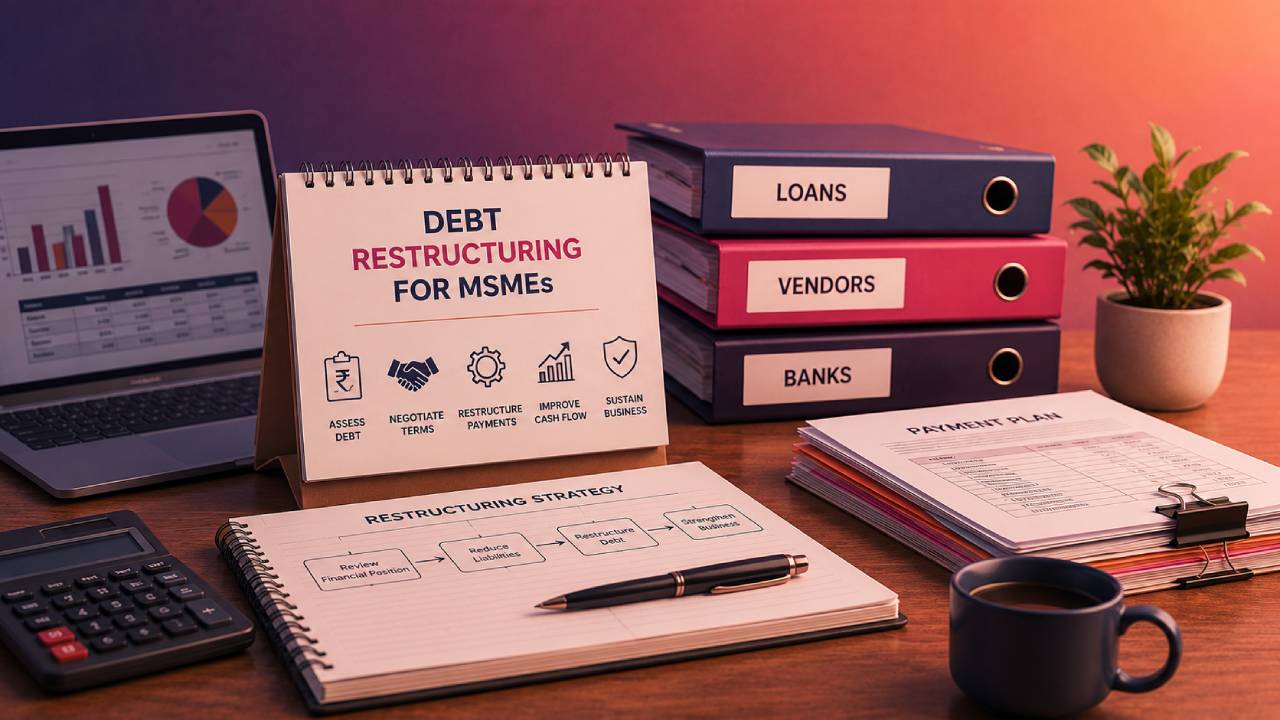
MSME debt restructuring can help a viable business manage repayment pressure when existing loan terms no longer match its cash flow. Restructuring may involve changing repayment schedules, extending the loan period, providing a moratorium, converting certain dues into another facility or making other changes permitted under the applicable banking framework. It is not an automatic right. The lender will usually examine the business’s financial position, repayment capacity, viability and the reasons behind the stress before considering a restructuring proposal.
For an MSME, early action matters. Waiting until repeated payment defaults, enforcement notices or serious deterioration in the account can reduce the practical options available. The right approach begins with understanding the debt, identifying the cause of financial stress and presenting a credible plan for future repayment.
What does MSME debt restructuring mean?
Debt restructuring involves changing the existing terms of a business’s borrowing so repayment becomes more manageable. The underlying debt does not necessarily disappear. Instead, the lender and borrower may agree on revised terms suited to the borrower’s financial position. Depending on the circumstances and applicable policy, this can include a longer repayment period, revised instalments, a moratorium, changes in interest treatment or conversion of certain dues into another form of credit. RBI’s regulatory framework distinguishes between different restructuring situations and regulated entities. Its current handbook refers to the Prudential Framework on Resolution of Stressed Assets dated 7 June 2019 and the Framework for Revival and Rehabilitation of MSMEs dated 17 March 2016 for specified MSME borrowers. This means an MSME should not assume an old one time restructuring scheme remains available. Several schemes found in older online articles were created for specific periods and circumstances.
Who can qualify as an MSME?
Eligibility should be checked using the current MSME classification rather than older figures. From 1 April 2025, the classification limits were revised. A micro enterprise can have investment up to ₹2.5 crore and turnover up to ₹10 crore. A small enterprise can have investment up to ₹25 crore and turnover up to ₹100 crore. A medium enterprise can have investment up to ₹125 crore and turnover up to ₹500 crore. The classification uses both investment and turnover criteria. The official Udyam Registration Portal provides the current registration framework and classification information. The MSME status of a borrower can be relevant when assessing whether a particular regulatory or rehabilitation framework applies. It should therefore be verified before preparing a restructuring proposal.
Why do MSMEs seek loan restructuring?
Financial stress can arise for many reasons. A temporary fall in sales, delayed receivables, loss of a major customer, rising input costs, unexpected capital expenditure or disruption in a supply chain can affect an otherwise viable business. Some businesses face a more structural problem. Their borrowing may have increased while margins have fallen. Working capital may be locked in receivables. The original repayment schedule may also have been based on assumptions about revenue or cash flow which no longer hold. A lender is more likely to take a restructuring proposal seriously when the borrower can distinguish temporary liquidity pressure from deeper business weakness. The central question is often simple: Can the business become capable of servicing its debt if the repayment structure is changed?
When should an MSME consider restructuring?
Restructuring is generally better considered before financial stress becomes severe. Warning signs can include repeated cash credit irregularities, delayed instalments, frequent requests for additional working capital, unpaid statutory dues, declining sales or growing dependence on short term borrowing. An MSME should also examine its account classification and repayment history. A stressed account may have fewer practical options once recovery proceedings or enforcement measures have begun. Early assessment allows the promoter to prepare financial information, examine lender policies and develop a realistic proposal instead of approaching the lender only after a default has escalated.
What does a lender examine before approving restructuring?
A lender will usually want evidence of viability and repayment capacity. The precise requirements vary between lenders and cases. Financial statements, GST records, income tax returns, bank statements, stock statements, debtor ageing, creditor details and projections may form part of the assessment. The lender may also examine the cause of stress. A business facing a short term cash flow mismatch presents a different risk from one facing sustained operating losses. Collateral, guarantees, existing security and the conduct of the account can also matter. The proposal should therefore explain not only how much the business owes but also why the revised structure should result in repayment.
What can a restructuring proposal include?
There is no single restructuring package suitable for every MSME. Depending on the applicable framework and lender policy, possible measures can include rescheduling instalments, extending the repayment period, providing a moratorium or dealing with accumulated interest through a permitted restructuring mechanism. A lender may also require additional promoter contribution, revised security arrangements or other conditions. The proposal should connect each requested concession to a specific cash flow problem. Asking for a longer repayment period without showing future repayment capacity is unlikely to address the lender’s concerns.
How should an MSME prepare a restructuring proposal?
A good proposal should start with a clear financial diagnosis. The business should calculate its total exposure across term loans, cash credit, overdrafts, working capital facilities, guarantees and other borrowings. It should then map repayment obligations against expected cash inflows. The next stage is to identify the cause of stress. If customers are paying late, receivables may be central to the problem. If margins have fallen, the business may need to demonstrate revised pricing or cost controls. Financial projections should be realistic. Inflated sales assumptions can weaken credibility. A useful proposal normally explains the present position, the cause of stress, steps already taken, projected cash flow, repayment capacity and the restructuring terms sought.
What documents are usually useful?
The exact documentation depends on the lender and restructuring framework. A borrower may need recent financial statements, GST returns, income tax returns, bank statements, stock and receivables information, details of creditors, details of existing borrowings and a statement explaining the financial stress. Where the business has multiple lenders, information concerning each facility becomes important. The borrower should also keep copies of sanction letters, loan agreements, security documents, guarantees and previous correspondence with lenders. Inconsistent figures across financial statements, GST records and bank statements should be reconciled before submitting a proposal.
Can an MSME negotiate with the bank for revised repayment terms?
A borrower can approach its lender with a restructuring proposal, subject to the lender’s applicable policy and regulatory framework. The outcome depends on the circumstances. Restructuring should not be described as an entitlement available merely because an enterprise is registered as an MSME. The lender has to assess credit risk, viability and compliance with applicable regulatory requirements. Negotiations can also become more complex where several banks or financial institutions are involved. The borrower may need a coordinated proposal covering the entire debt position.
What if the MSME has loans from several lenders?
Multiple lenders can make restructuring more complicated. The borrower may have separate term loans, working capital facilities and other exposures with different institutions. A proposal involving only one lender may not solve the overall cash flow problem. The borrower should prepare a consolidated debt statement showing the lender, facility, outstanding amount, security, repayment schedule and current account status. A coordinated restructuring strategy can then be considered where the applicable framework permits it. The presence of multiple lenders also makes accurate financial information more important because each lender may assess the proposal independently or within a coordinated arrangement.
What happens if the account has become an NPA?
An MSME should not assume restructuring and NPA resolution are interchangeable. Once an account is classified as a non performing asset, the lender may have recovery and enforcement options under applicable law. Depending on the security and circumstances, measures under the SARFAESI Act or proceedings before the Debt Recovery Tribunal may become relevant. The borrower should therefore review the account status and any notices received before proposing a restructuring. A proposal made after enforcement has started may require a different strategy from an early stage restructuring request.
Can restructuring prevent recovery action?
Not automatically.
A restructuring request does not by itself create a blanket protection against enforcement. The legal position depends on the applicable regulatory framework, lender action, contractual documents and stage of the account. If an MSME receives a demand notice, possession notice, recall notice or other recovery communication, it should examine the document promptly. Where enforcement has already begun, the restructuring discussion may need to be considered alongside available legal remedies.
What role does the RBI play in MSME restructuring?
The Reserve Bank of India regulates banks and several categories of financial institutions and establishes prudential frameworks for dealing with stressed assets. Older RBI material contains specific MSME debt restructuring mechanisms. Some of those provisions relate to historical schemes and should not be presented as current automatic restructuring rights. The RBI’s more recent regulatory material continues to recognise frameworks dealing with stressed assets and MSME revival and rehabilitation. The lender’s current restructuring policy and the regulatory framework applicable to the particular facility should therefore be checked at the time of making the proposal.
Can an MSME use the revival and rehabilitation framework?
The RBI’s Framework for Revival and Rehabilitation of MSMEs provides a mechanism for addressing stress in eligible MSME borrower accounts within the framework specified by RBI. RBI’s current handbook continues to identify this framework for MSME borrowers whose aggregate exposure with all commercial banks is within the specified threshold. The exact applicability should be verified against the current RBI directions and the borrower’s exposure, account status and lender category. This route is different from simply asking a bank to reduce the EMI. It forms part of a broader framework for dealing with stressed MSME accounts.
What if the lender rejects the restructuring request?
A rejection does not necessarily mean every legal option has ended. The borrower should first understand why the request was rejected. The reason may relate to inadequate viability, insufficient information, account classification, previous restructuring, security concerns or the lender’s policy. A revised proposal may be possible in some circumstances. In other cases, the business may need to examine settlement, refinancing, sale of assets, additional capital or a formal insolvency route. The response should be based on the actual financial position rather than repeated requests for more time.
Can an MSME seek a one time settlement instead?
A one time settlement is different from restructuring. Restructuring generally seeks to modify repayment terms so the borrower can continue servicing the debt. A settlement involves an agreed payment of an amount in satisfaction of the lender’s claim, subject to the terms of the settlement. An OTS may become relevant where the business is unable to sustain the existing debt structure but can arrange a lump sum or other agreed payment. The tax, accounting, credit reporting, guarantee and security consequences should be considered before accepting a settlement.
When can insolvency restructuring become relevant?
For a corporate MSME facing serious financial distress, the Insolvency and Bankruptcy Code contains a specialised Pre Packaged Insolvency Resolution Process. The PPIRP was introduced specifically for corporate persons classified as MSMEs. It operates under Chapter III A of Part II of the IBC and is supported by the IBBI regulations. The current IBBI legal framework shows the PPIRP Regulations continue to be amended and maintained, including amendments issued in 2026. PPIRP is not simply another form of bank loan restructuring. It is a statutory insolvency resolution process with its own eligibility requirements, creditor participation and procedural safeguards. It should therefore be considered only after examining whether the business and its financial circumstances meet the relevant statutory conditions.
How does PPIRP differ from ordinary loan restructuring?
Ordinary restructuring generally involves negotiation or resolution between a borrower and its lender or lenders within the applicable banking framework. PPIRP is a formal insolvency process under the IBC. One significant feature is its debtor in possession structure, subject to the statutory framework. The existing management can continue to operate the business during the process, while creditors retain important rights within the process. The purpose is to provide an insolvency resolution route designed for MSMEs while seeking to preserve business continuity and value. IBBI has continued to maintain and amend the relevant regulations in 2026.
What legal issues should promoters examine before restructuring?
Promoters should review more than the repayment schedule. Loan documentation may contain representations, undertakings, security obligations, financial covenants and events of default. Personal guarantees may also expose promoters to separate liability. The borrower should review whether any guarantee has been invoked, whether security enforcement has begun and whether any litigation or arbitration is pending. It is also important to examine related party transactions, asset transfers and payments to connected parties if the business is approaching insolvency. Transactions undertaken during financial distress can create additional legal complications. For an MSME facing complex lender negotiations or enforcement, msme attorneys in india can assist in examining the legal position alongside the financial restructuring strategy.
Can restructuring affect the credit profile of an MSME?
Yes, restructuring can have consequences for the borrower’s credit profile and future access to finance. The precise effect depends on the applicable regulatory treatment, account status, lender reporting and restructuring terms. A borrower should therefore consider the longer term consequences before accepting revised terms. Lower immediate instalments may improve cash flow but can increase the overall repayment period or cost. The business should compare the total economic impact rather than focusing only on the monthly instalment.
What mistakes should an MSME avoid?
One common mistake is approaching the lender without a workable financial plan. Another is presenting projections unsupported by historical performance. A lender is likely to compare proposed revenue and margins against actual figures. Ignoring unpaid statutory dues, supplier liabilities or personal guarantees can also produce an incomplete picture. A further mistake is waiting until enforcement action is imminent before seeking advice. The restructuring proposal should reflect the entire financial position of the business, not only the bank loan.
A practical restructuring plan for an MSME
The process can be approached in stages.
- First, establish the current debt position. Identify every lender, facility, outstanding amount, security and repayment obligation.
- Second, diagnose the reason for stress. Separate temporary liquidity pressure from long term business weakness.
- Third, prepare realistic financial projections. Show expected revenue, operating expenses, working capital needs and cash available for debt servicing.
- Fourth, identify the restructuring terms required. The request should be linked to the cash flow problem.
- Fifth, review the legal documents. Loan agreements, security documents, guarantees and lender correspondence should be examined before negotiations.
- Sixth, approach the relevant lender or lenders with a coherent proposal supported by financial records.
- Finally, assess alternatives if restructuring is not viable. These may include refinancing, settlement, additional promoter capital, asset monetisation or an appropriate insolvency process.
A business and corporate lawyer can be useful where restructuring involves several lenders, guarantees, security enforcement, shareholder issues or related contractual disputes.
Is MSME debt restructuring the same as loan waiver?
No.
Restructuring normally changes the terms of repayment. It does not automatically cancel the underlying debt. A waiver involves forgiveness of all or part of an obligation under an applicable arrangement. A settlement may involve acceptance of a specified amount in satisfaction of a debt. These concepts have different legal and financial consequences. An MSME should therefore avoid assuming a restructuring proposal will reduce the principal unless the lender expressly agrees to such a term.