
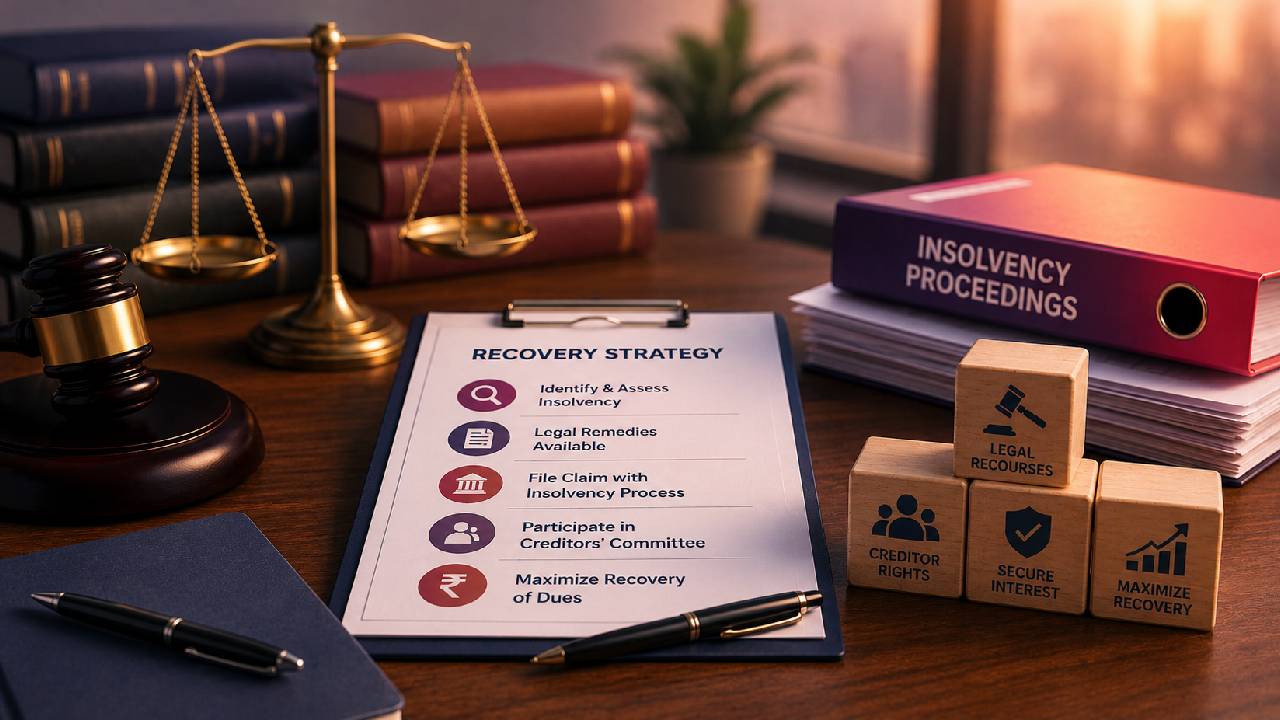
Recovering money from an insolvent company requires a different strategy from ordinary debt recovery. Once insolvency proceedings begin, an individual creditor cannot usually pursue the company as though it were a normal commercial debtor. The insolvent company recovery process is governed primarily by the Insolvency and Bankruptcy Code, 2016, along with the applicable regulations and orders of the National Company Law Tribunal.
The immediate priority is to identify the company’s status. It may be facing financial stress without formal insolvency proceedings. It may be undergoing the Corporate Insolvency Resolution Process, or CIRP. It may already be in liquidation. Each stage affects the creditor’s rights, the procedure for submitting a claim and the prospects of receiving payment.
What happens when a company becomes insolvent?
Insolvency does not simply mean a company has stopped paying one creditor. Under the IBC, insolvency proceedings follow a statutory process once the relevant conditions and procedures are satisfied. For a creditor, the most important change is control over recovery. Once CIRP begins, the management of the company’s affairs moves into the insolvency framework and the resolution professional takes the role prescribed under the Code. A moratorium may also restrict certain proceedings against the corporate debtor. The purpose of CIRP is not merely to collect debts. It seeks resolution of the company’s financial distress while preserving value where possible. A successful resolution plan can result in payment to creditors even though the company could not meet its original contractual obligations. If resolution fails and liquidation follows, recovery depends on the assets available and the statutory distribution mechanism.
The first step is to check the company’s insolvency status
Before starting recovery proceedings, a creditor should establish whether formal insolvency proceedings have commenced. The IBBI maintains public information concerning insolvency cases, including claim related information filed during CIRP. The creditor should verify the corporate debtor’s name, CIN, date of commencement of CIRP or liquidation, the appointed insolvency professional and the relevant public announcement. This distinction is important. A company may have stopped paying invoices without entering CIRP. In such a situation, ordinary contractual remedies, arbitration, civil proceedings or statutory recovery routes may still be available, subject to the nature of the debt. Once CIRP has commenced, the creditor must work within the insolvency process.
Can a creditor recover money during CIRP?
Yes, but usually through the insolvency process rather than by pursuing the company independently. A creditor must submit its claim in the prescribed manner to the interim resolution professional or resolution professional. The claim needs supporting evidence. Depending on the creditor’s category, different forms and documentary requirements apply. The CIRP regulations provide mechanisms for financial creditors, operational creditors and other creditors to submit claims with proof. The regulations also permit the resolution professional to seek further evidence or clarification when verifying a claim. For an operational creditor, documents may include contracts, purchase orders, invoices, delivery records, correspondence, ledger statements and evidence showing non payment. A creditor should not rely only on an unpaid invoice. The stronger the documentary trail, the easier it is to establish the amount and existence of the debt.
Who is an operational creditor?
An operational creditor generally has a claim arising from the provision of goods, services, employment or certain statutory dues covered by the IBC. Suppliers, service providers and contractors commonly fall within this category. The distinction matters because the IBC gives different rights to financial creditors and operational creditors. An operational creditor does not ordinarily have the same role within the Committee of Creditors as a financial creditor. A creditor should therefore identify its correct category before submitting a claim or considering insolvency proceedings.
What documents are needed to prove the debt?
The evidence should establish both the existence of the debt and the amount outstanding. For a commercial supplier, useful records may include the executed agreement, purchase orders, invoices, delivery challans, goods receipt notes, email correspondence, account statements and proof of partial payments. For service providers, the contract, work records, completion evidence, invoices and correspondence acknowledging the outstanding amount can be important. Bank statements can also help demonstrate non payment. Where available, information recorded with an information utility can provide further evidence of the debt. The creditor should reconcile its internal ledger before filing the claim. Differences between invoices, ledger balances, GST records and bank statements can create unnecessary disputes during verification.
What happens after a creditor files its claim?
The resolution professional examines claims and determines the amount admitted, subject to the applicable regulations. The IBBI’s published claim records show how claims may be categorised into secured financial creditors, unsecured financial creditors, operational creditors, employees, government dues and other creditors. A creditor should therefore monitor the status of its claim rather than assuming submission means automatic admission. If the amount admitted differs from the amount claimed, the creditor should examine the reasons and supporting records. A disputed or partly admitted claim can materially affect the eventual recovery.
What if the resolution professional rejects part of the claim?
A creditor should first understand why the amount was not admitted. The issue may concern limitation, insufficient documents, disputed invoices, calculation of interest, set off, contractual conditions or a difference in the date on which the debt arose. The creditor can provide additional documents or clarification where permitted. If a substantive dispute remains, the creditor may need to consider the appropriate remedy before the relevant forum. The key point is to act promptly. Insolvency proceedings operate within statutory timelines, and delay can make recovery more difficult.
Does an operational creditor receive the same payment as a financial creditor?
Not necessarily.
The treatment of creditors depends on the resolution plan during CIRP and the statutory framework governing liquidation if the company enters liquidation. The Supreme Court has recognised the commercial role of the Committee of Creditors in approving resolution plans, while the IBC contains specific requirements concerning the treatment of operational creditors. The amount a creditor ultimately receives can therefore be considerably different from the amount admitted. Admission establishes the claim within the insolvency process. It does not guarantee full repayment.
What happens if the company goes into liquidation?
Liquidation changes the recovery process. The liquidator takes control of the liquidation estate and realises the company’s assets in accordance with the IBC and the applicable regulations. Creditors must submit or update their claims with the liquidator. The liquidation regulations specifically provide mechanisms for stakeholders to submit claims and require proof of the debt. Operational creditors can establish their claims through contracts, invoices, financial accounts and other relevant records. The amount recovered then depends on the assets realised, costs of liquidation and the statutory priority structure.
How does the Section 53 waterfall affect recovery?
Section 53 of the IBC sets out the order in which liquidation proceeds are distributed. In broad terms, insolvency resolution process costs and liquidation costs receive priority. Certain workmen’s dues and secured creditor claims follow under the statutory structure. Unsecured financial creditors rank later, followed by specified government dues and other debts, with equity interests at the bottom of the waterfall. The exact statutory wording and current amendments should always be checked before advising on a particular distribution. The current text of Section 53 is available through India Code’s statutory text for Section 53.
This priority structure explains why a creditor may have an admitted claim but still recover only part of the amount.
Can an unsecured creditor recover money from liquidation?
Yes, an unsecured creditor can submit a claim in liquidation. Recovery depends on the statutory waterfall and the assets available for distribution. An unsecured operational creditor usually ranks below several categories of claims under Section 53. The practical result is important. A creditor should assess the likely liquidation value before spending significant resources pursuing recovery. An admitted claim of ₹1 crore does not mean the creditor will receive ₹1 crore.
Can a secured creditor recover outside liquidation?
A secured creditor has specific rights under the IBC concerning security interests. Section 52 permits a secured creditor, subject to the statutory requirements, to either relinquish its security interest to the liquidation estate and receive distribution through the waterfall or realise the security interest in the manner provided by the Code. The choice can have significant financial consequences. The value of the security, enforceability of the charge, competing interests and costs of enforcement should all be considered before choosing a recovery strategy.
What if the company transferred its assets before insolvency?
This can become a serious issue. The IBC contains provisions concerning preferential transactions, undervalued transactions, transactions defrauding creditors and extortionate credit transactions. If assets were transferred to connected parties or consideration was significantly below value, the resolution professional or liquidator may examine the transaction under the applicable provisions. A creditor should preserve evidence of suspicious transfers, including corporate filings, property records, transaction documents, bank records and communications. Recovery may sometimes depend on tracing value rather than simply proving the original debt.
Can directors be personally liable for the company’s debt?
A company’s debt is generally not automatically a personal debt of its directors. However, personal liability can arise in specific circumstances. A director or promoter may have provided a personal guarantee. There may also be liability arising from fraud, wrongful conduct or statutory breaches. Personal guarantors to corporate debtors are subject to a separate insolvency framework under the IBC. The IBBI’s current legal framework separately lists regulations governing insolvency resolution for personal guarantors to corporate debtors. A creditor should therefore examine guarantees and related documents before assuming its only remedy lies against the corporate debtor.
Can a creditor initiate CIRP against a company?
In suitable cases, a financial creditor may initiate CIRP under Section 7 of the IBC, while an operational creditor may initiate proceedings under Section 9 subject to the statutory requirements. This is not simply another debt recovery suit. The purpose of a Section 7 or Section 9 proceeding is to invoke the insolvency resolution process upon establishment of the required financial or operational debt and default. An operational creditor must also comply with the statutory demand notice procedure and consider whether a pre existing dispute exists. The decision to initiate insolvency proceedings should therefore be based on more than the amount outstanding. The creditor should consider the debtor’s financial position, available assets, evidence of default and the likely commercial outcome.
Is insolvency always the best recovery option?
No.
If the company has sufficient assets and the debt is relatively straightforward, ordinary recovery proceedings may sometimes be more appropriate. Depending on the contract, the creditor may have rights through arbitration, civil proceedings or other statutory mechanisms. If the company is genuinely insolvent, however, individual recovery action may produce limited results because other creditors may also have claims. A coordinated insolvency strategy can provide a structured route for dealing with competing claims.
What if the company has not yet entered insolvency?
This is often the stage where creditors have greater flexibility. A creditor may consider issuing a contractual demand, negotiating a payment plan, invoking arbitration, filing an appropriate civil or commercial claim or issuing a statutory demand where the relevant requirements are satisfied. For an operational creditor considering Section 9 proceedings, the existence of a genuine pre existing dispute is particularly important. Insolvency proceedings should not be used as a substitute for ordinary debt collection where the statutory requirements are not met. Early legal assessment can therefore prevent an inappropriate insolvency filing.
Can a creditor settle with an insolvent company?
A settlement may be possible in appropriate circumstances, subject to the stage of the insolvency process and the powers of the relevant parties. During CIRP, a settlement may require compliance with the IBC framework and applicable judicial directions. After liquidation begins, the liquidator’s powers and the statutory framework become important. A settlement should clearly record the amount payable, payment dates, treatment of the remaining debt, security, guarantees and consequences of default. A creditor should also consider whether accepting a settlement affects any separate claim against a guarantor or other party.
How should a creditor maximise its recovery?
The creditor should start with evidence. A complete debt file should contain the agreement, invoices, correspondence, delivery records, payment history, account statements and security documents. Next, the creditor should establish the debtor’s current status. The company’s financial position, CIRP or liquidation status and available assets can materially change the recovery strategy. The creditor should then calculate the realistic recovery value. A large unsecured claim against a company with few assets may have limited practical value. Finally, the creditor should choose the forum and procedure carefully. Filing the wrong proceeding can consume time and increase costs without improving recovery prospects. For complex claims involving insolvency proceedings, security enforcement or suspected asset transfers, restructuring and insolvency lawyers can help assess the available legal routes and their likely consequences.
Common mistakes creditors make
One common mistake is treating insolvency as ordinary debt recovery. Another is submitting an incomplete claim. Missing invoices, contracts or proof of delivery can create difficulties during verification. Some creditors also fail to monitor the insolvency process after submitting a claim. Admission, voting rights, resolution plans and distribution can affect the final outcome. A further problem arises when creditors ignore limitation issues. The insolvency process does not create an unlimited period for pursuing an old debt. Creditors should also avoid assuming the company’s promoters will personally pay the debt. Personal liability requires an independent legal basis.
What happens after a resolution plan is approved?
Once a resolution plan is approved by the Adjudicating Authority, its terms become important for creditors. The approved plan determines the treatment of different creditor classes and the payments due under the plan. A creditor should examine the plan carefully to understand the amount payable, payment schedule, conditions and treatment of any residual claim. An admitted claim does not necessarily survive in its original contractual form after an approved resolution plan takes effect. This is one reason creditors should participate actively in the insolvency process rather than treating claim filing as the end of the matter.
Is recovery possible after liquidation is completed?
Once the liquidation process reaches completion, the scope for recovering against the corporate debtor becomes extremely limited. A creditor’s position depends on whether its claim was submitted and admitted, whether assets were available for distribution and whether any independent cause of action exists against another liable party. Separate rights against guarantors or other parties may require independent examination. A creditor should therefore identify all potential sources of recovery before the corporate debtor’s assets are finally distributed.
Practical checklist for creditors
A creditor dealing with an insolvent company should first confirm whether CIRP or liquidation has started. It should then identify its creditor category and collect documents proving the debt. The claim amount should be reconciled with the company’s records and any applicable interest or contractual charges should be calculated carefully. The creditor should monitor the public announcements, submit the claim within the applicable period and respond promptly to requests from the insolvency professional. Where the claim is disputed or partly rejected, the creditor should examine the reason and consider the appropriate remedy. Finally, the creditor should assess the realistic recovery value rather than relying only on the face value of the debt.