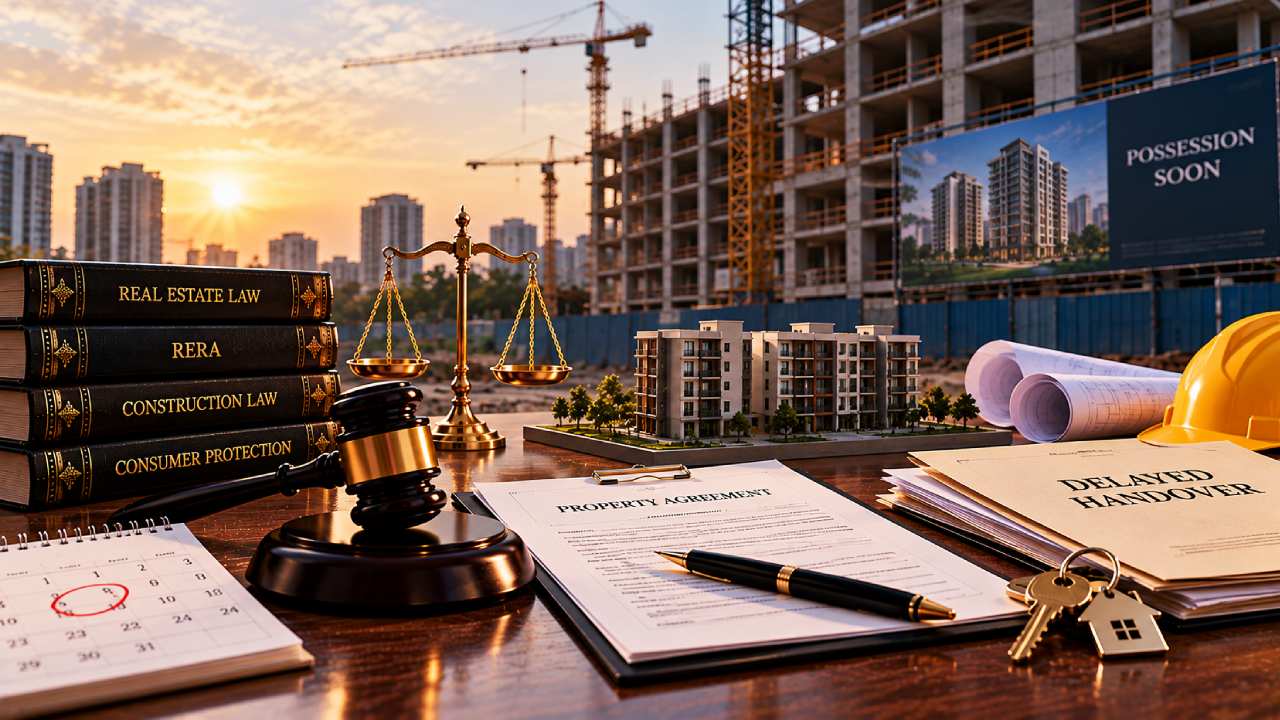

Redevelopment can offer existing residents safer buildings, larger homes, better amenities and financial benefits. However, disputes arise when a developer fails to deliver the promised flat area, delays possession, withholds transit rent or leaves common facilities incomplete. Understanding redevelopment project legal rights helps residents identify who may be held accountable and which remedies are available under Indian law.
Liability depends on the redevelopment agreement, individual permanent alternate accommodation agreements, sanctioned plans and the conduct of each party. The developer is often primarily responsible for construction and promised benefits, but a housing society, contractor or public authority may also be accountable where its own contractual or statutory duties have been breached.
Who Is Primarily Liable for Failing to Deliver Redevelopment Benefits?
The developer is generally the first party to examine when promised benefits are not delivered. Under a typical redevelopment arrangement, the developer receives development rights in return for demolishing or reconstructing the existing building and providing agreed benefits to eligible residents. These may include a replacement flat of specified carpet area, temporary accommodation or rent, shifting expenses, corpus payments, parking and common amenities.
If the developer fails to meet these obligations without a valid contractual or legal justification, residents may pursue remedies for breach of contract and, where applicable, statutory non compliance. Depending on the agreement and evidence, relief may include payment of outstanding rent, completion of promised work, compensation, interest or other appropriate directions.
The terms of the agreement are crucial. A marketing brochure or verbal assurance may help establish what was represented, but an executed development agreement, permanent alternate accommodation agreement, approved plan and written correspondence usually provide stronger evidence. Residents should establish precisely what was promised, when performance became due and how the failure caused loss.
Can a Housing Society or Residents’ Association Also Be Held Responsible?
A cooperative housing society or residents’ association may be responsible for its own decisions and obligations. It may have selected the developer, executed the development agreement, approved project terms or undertaken to facilitate possession and handover. If its office bearers act beyond their authority, disregard applicable procedures, misrepresent material facts or fail to perform obligations expressly undertaken by the society, legal consequences may follow.
However, the society is not automatically liable for every default by the developer. Its responsibility depends on the agreement, applicable state cooperative laws, the authority of its representatives and the facts of the dispute. Individual office bearers are not automatically personally liable merely because they hold society positions. Personal liability generally requires a recognised legal basis, such as their own wrongful conduct or an enforceable personal undertaking.
Residents should therefore examine the development agreement alongside the society’s resolutions, general body meeting minutes and correspondence. These documents help determine whether the society breached an independent obligation or whether the dispute principally concerns the developer’s failure to perform.
What If the Promised Flat Area, Rent or Corpus Is Not Provided?
The legal position depends on the benefit in question and the documents recording it. If a resident was promised a replacement flat of a particular carpet area but receives a smaller unit, the discrepancy may support a claim for enforcement, compensation or another remedy available under the agreement and applicable law.
Similarly, where the developer agreed to pay monthly transit rent until possession or completion of a specified milestone, unpaid instalments may amount to a contractual default. The same applies to agreed shifting charges, brokerage, hardship compensation or corpus payments. Residents should check whether the agreement specifies payment dates, escalation, conditions and the event which ends the developer’s obligation.
Missing amenities require a separate assessment. A facility mentioned in a binding agreement, sanctioned plan or legally relevant representation may be enforceable, depending on the circumstances. A resident’s expectation of an unrecorded facility, however, may be more difficult to establish. Photographs, approved plans, specifications, payment records and written commitments can help distinguish a contractual shortfall from a misunderstanding about the project.
How Does RERA Protect Existing Residents in Redevelopment Projects?
The Real Estate (Regulation and Development) Act, 2016, commonly known as RERA, can provide important protections where a redevelopment project falls within its scope. The Act regulates covered real estate projects and imposes obligations on promoters, including requirements concerning registration, disclosures, adherence to sanctioned plans and fulfilment of applicable commitments to allottees.
Under Section 31, an aggrieved person may lodge a complaint with the relevant Real Estate Regulatory Authority or adjudicating officer, as appropriate under the Act and applicable rules. Section 18 addresses specified situations involving failure to complete or give possession in accordance with the agreement, while other provisions may be relevant to deviations, disclosures and promoter obligations.
However, RERA does not automatically govern every dispute between a housing society and a developer. Whether existing residents qualify as allottees for a particular claim, whether the project requires registration and whether the requested relief falls within the authority’s jurisdiction must be assessed against the statutory framework and facts. Residents should check the relevant state RERA rules and project registration before choosing this route. The official text of the Real Estate (Regulation and Development) Act, 2016 provides the starting point for reviewing the statutory provisions.
Can Contractors, Architects or Public Authorities Be Liable?
A contractor may be accountable where defective or incomplete work breaches its contract with the developer or another contracting party. An architect or consultant may face liability where professional negligence or a breach of duty is established. Yet residents cannot assume they have a direct contractual claim against every professional engaged on the project. The relevant contract, statutory duties and evidence determine whether a direct remedy is available.
Public authorities may also have responsibilities relating to building permissions, safety requirements, planning compliance or occupation certificates. Their role is distinct from the developer’s contractual promises. An authority is not ordinarily responsible for paying a developer’s unpaid transit rent or delivering a promised corpus simply because it approved the project.
Where an approval has been unlawfully withheld, a statutory duty has been breached or an administrative decision is challenged, a separate public law or statutory remedy may be appropriate. Residents should distinguish an authority’s regulatory responsibility from a private party’s contractual default.
What Legal Remedies Can Residents Pursue?
The appropriate remedy depends on the nature of the failure, the contract and the forum with jurisdiction. Residents may consider a formal demand for performance, a claim for unpaid contractual benefits, compensation for proven loss, or proceedings seeking enforcement of enforceable obligations. In suitable cases, they may also seek interim protection to prevent further prejudice while a dispute is being decided.
A consumer complaint may be available where the relationship and grievance fall within the Consumer Protection Act, 2019. The Act provides a framework for complaints concerning qualifying deficiencies in services and other recognised consumer grievances. Whether a particular redevelopment arrangement qualifies, and which relief is available, must be assessed on its facts. The official Consumer Protection Act, 2019 sets out the statutory framework.
If the agreement contains a valid arbitration clause, arbitration may be an option for disputes covered by the clause. Residents should review its scope, appointment procedure, seat and venue provisions, and any conditions precedent. Arbitration is not automatically the correct route for every redevelopment dispute, particularly where statutory remedies, non signatories or questions of jurisdiction are involved. Advice from arbitration lawyers for dispute resolution can help assess whether arbitration is appropriate and how it interacts with other available proceedings.
Residents should also consider whether the claim belongs to individual members, the society collectively or both. Separate claims concerning personal rent or flat area may require a different approach from disputes over termination of the development agreement or control of the entire project.
What Should Residents Do When a Developer Defaults?
Residents should begin by collecting the development agreement, individual permanent alternate accommodation agreements, society resolutions, approved plans, payment records, rent statements, notices and written assurances. They should prepare a clear timeline covering the date of vacating, promised payment dates, construction milestones, possession deadlines and communications about delays.
The society should record the alleged defaults formally and avoid relying solely on informal discussions. A written notice can identify each unmet obligation, cite the relevant contractual clause, request a specific remedy and set a reasonable response period where appropriate. Residents should preserve proof of delivery and avoid signing waivers, revised terms or settlement documents without understanding their effect.
Before terminating a development agreement, appointing a replacement developer or taking possession of disputed premises, the society should obtain advice on the contractual termination provisions, notice requirements, approvals and any pending proceedings. An improperly executed termination may create further litigation. Real estate redevelopment lawyers can help assess the agreements, identify responsible parties and determine the most suitable legal route.
Conclusion
When a redevelopment project fails to provide promised benefits, the developer is often the primary party to examine, but liability is not automatic or exclusive. The housing society, professional consultants or public authorities may have separate responsibilities where their own contractual or statutory duties have been breached. Residents should identify the exact obligation, preserve documentary evidence and select a remedy suited to the dispute. A careful review of the redevelopment agreement, applicable state rules and available statutory forums can help protect residents’ rights while reducing the risk of avoidable litigation.