
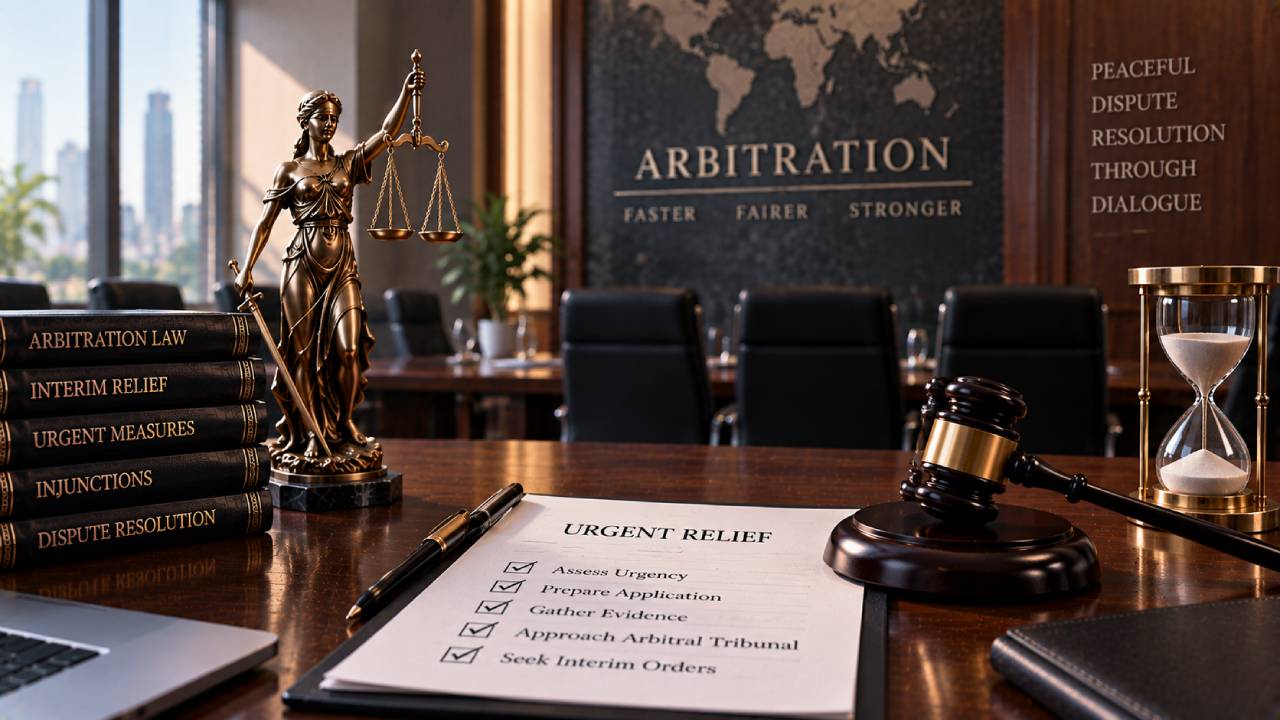
An arbitration can take months to reach a final award. In the meantime, assets may be transferred, confidential information may be disclosed, a bank guarantee may be invoked, goods may deteriorate or a contractual relationship may be irreversibly altered. In such situations, interim relief arbitration mechanisms allow a party to seek immediate protection before the dispute is finally decided.
Indian arbitration law provides more than one route for urgent protection. A party can approach a court under Section 9 of the Arbitration and Conciliation Act, 1996. Once an arbitral tribunal is constituted, the tribunal can ordinarily grant interim measures under Section 17. Institutional arbitration rules may also provide for an emergency arbitrator. Choosing the correct route depends on the stage of the dispute, the arbitration agreement, the urgency involved and the effectiveness of the available remedy.
What is interim relief in arbitration?
Interim relief is temporary protection granted before the final determination of the dispute. Its purpose is not normally to decide the underlying claim. Instead, it protects the subject matter of the arbitration or prevents circumstances from developing which could make the eventual award ineffective.
Section 9 expressly permits a party to seek interim measures from a court before or during arbitral proceedings and, in specified circumstances, after an award but before its enforcement. The statutory examples include preservation or custody of goods, securing the amount in dispute, inspection or preservation of property, interim injunctions and appointment of a receiver. The provision also allows the court to grant other protective measures where appropriate. This means a party does not necessarily have to wait for the arbitral tribunal to be constituted before seeking protection.
When can urgent relief be sought before arbitration begins?
One of the most important features of Section 9 is its availability before commencement of arbitral proceedings. Consider a situation where a contracting party is about to sell disputed machinery, transfer valuable assets, invoke a bank guarantee in circumstances prohibited by the contract or disclose confidential business information. Waiting several months for constitution of the tribunal may defeat the purpose of arbitration. Section 9 allows the affected party to approach the competent court for appropriate interim protection. The relief must still have a genuine connection with the arbitration and must satisfy the legal principles governing interim measures.
Where a court grants an interim measure before arbitration commences, Section 9(2) requires the arbitral proceedings to be commenced within ninety days from the date of the court’s order, or within such further period as the court determines. This is an important practical deadline. A party should therefore have a realistic plan for commencing arbitration before seeking pre arbitration protection.
What types of urgent relief can a court grant under Section 9?
The statutory language of Section 9 is deliberately broad. Depending on the circumstances, a court may preserve goods or property, secure an amount in dispute, permit inspection or evidence preservation, grant an interim injunction or appoint a receiver. For example, a party might seek an injunction preventing disposal of identified assets connected with the dispute. Another case may require preservation of machinery or documents. A shareholder dispute may require temporary protection against an action capable of fundamentally altering the subject matter of the arbitration.
A monetary claim can also justify protective measures in appropriate circumstances. The Supreme Court has recognised the court’s power under Section 9 to secure the amount in dispute and has explained that the applicant must establish a good prima facie case, balance of convenience and reasonable expedition in approaching the court. The relief sought should therefore be carefully connected to the risk. A court is more likely to consider a precisely framed protective request than a broad application seeking to effectively obtain the final relief before the arbitration begins.
What does the court consider before granting interim relief?
A Section 9 application is not an automatic remedy merely because an arbitration agreement exists. The Supreme Court has explained that the familiar principles governing interim injunctions remain relevant. The applicant generally needs to demonstrate a strong prima facie case, balance of convenience and the possibility of irreparable injury or prejudice if protection is refused.
The court also considers whether the applicant has acted with reasonable expedition. Delay can weaken an assertion of urgency. This is particularly important in commercial disputes. If a party knew about an alleged breach several months earlier but took no meaningful action, it may become more difficult to persuade the court that an emergency exists. The application should therefore explain not only what may happen, but also why immediate intervention is necessary now.
Can a court order urgent relief after the arbitral tribunal is constituted?
Yes, but Section 9(3) introduces an important limitation. Once the arbitral tribunal has been constituted, the court ordinarily should not entertain a Section 9 application if the remedy under Section 17 is efficacious. The purpose is to respect the tribunal’s role and reduce unnecessary court intervention during an ongoing arbitration.
However, Section 9(3) is not an absolute prohibition. The court can still intervene where circumstances exist which may make the remedy under Section 17 ineffective. The Supreme Court in ArcelorMittal Nippon Steel India Ltd v Essar Bulk Terminal Ltd explained the relationship between Sections 9 and 17. It recognised that there can be circumstances where the tribunal’s remedy is not efficacious even after constitution of the tribunal. The Court also emphasised the urgent nature of interim applications and the need to prevent arbitration from becoming ineffective. The practical question is therefore not simply whether the tribunal exists. It is whether the tribunal can provide effective protection in the circumstances requiring immediate intervention.
Section 9 versus Section 17: which remedy should you use?
Section 9 gives the court power to grant interim protection. Section 17 gives corresponding powers to the arbitral tribunal during arbitral proceedings. Section 17 allows the tribunal to order preservation or custody of goods, securing the amount in dispute, inspection and preservation of property, interim injunctions, appointment of a receiver and other protective measures. An order passed by the tribunal under Section 17 is enforceable in the same manner as an order of the court under the Code of Civil Procedure, subject to the statutory framework.
The distinction becomes especially important once the tribunal is functioning. If the tribunal can hear and decide the application quickly, Section 17 may be the appropriate forum. If the tribunal has not yet been constituted, Section 9 may be the immediate judicial route. If the tribunal exists but cannot provide effective relief in the circumstances, Section 9 may still remain relevant. The choice should therefore be based on timing, effectiveness and the nature of the risk, rather than simply choosing the forum perceived to be more powerful.
What is emergency arbitration?
Emergency arbitration provides another mechanism for obtaining urgent protection before the constitution of the full arbitral tribunal, particularly in institutional arbitration. Several institutional arbitration rules provide for appointment of an emergency arbitrator where immediate interim protection is required. The precise procedure depends on the applicable institutional rules and the arbitration agreement.
Indian law has an important Supreme Court authority on this subject. In Amazon.com NV Investment Holdings LLC v Future Retail Ltd, the Supreme Court recognised the enforceability of an emergency arbitrator’s order in an India seated arbitration within the statutory framework of Section 17. The decision is widely regarded as a significant development in Indian arbitration law.
The position can be more complicated for foreign seated arbitrations. An emergency arbitrator’s order may not automatically operate in India in the same manner as an India seated emergency order. In such circumstances, a party may need to seek appropriate relief from an Indian court under Section 9. This distinction should be examined carefully before relying exclusively on emergency arbitration.
Can an emergency arbitrator’s order be enforced in India?
The answer depends significantly on the seat of arbitration and the applicable legal framework. The Supreme Court’s decision in Amazon v Future Retail established an important principle for India seated arbitration by treating the emergency arbitrator within the Section 17 framework for enforcement purposes.
Foreign seated arbitration requires a different analysis. Indian courts may independently consider an application under Section 9 rather than simply treating a foreign emergency order as directly enforceable in India. The Delhi High Court has recently reiterated that an emergency arbitrator’s order does not automatically bind a court exercising jurisdiction under Section 9. The court must independently assess the entitlement to interim relief under Indian law. Businesses involved in cross border transactions should therefore examine the arbitration clause, institutional rules and seat before an emergency arises.
What are the grounds for obtaining urgent interim protection?
The factual foundation of the application is often as important as the legal provision relied upon. A party seeking urgent relief should demonstrate a specific and credible risk. Examples may include imminent disposal of assets, destruction or alteration of evidence, threatened transfer of disputed property, invocation of contractual security in breach of agreed conditions, leakage of confidential information or conduct capable of defeating the eventual award.
The Supreme Court has clarified that an applicant seeking security under Section 9 does not necessarily have to establish actual attempts to remove or dispose of property. A strong possibility of diminution of assets may be sufficient, depending on the facts. This makes evidence critical. General allegations about financial difficulty may be insufficient. Bank records, public filings, correspondence, transaction documents, notices, corporate records and other contemporaneous material may help establish the urgency.
Can an ex parte interim order be obtained?
In a genuinely urgent case, a party may seek an ad interim order without waiting for the other side to fully respond, subject to the court’s discretion and procedural requirements. Such relief is exceptional because the court is being asked to restrict a party’s conduct before hearing the opposing side fully. The applicant therefore needs to present the urgency, legal basis and supporting evidence with particular care.
Full and frank disclosure is important. Suppression of material facts can undermine the credibility of the applicant and may result in the interim order being modified or vacated. The relief should also be proportionate. The court is more likely to consider a narrowly tailored order designed to preserve the subject matter than an application effectively seeking final adjudication at the interim stage.
Businesses facing an immediate risk should consult arbitration lawyers for urgent relief early enough to assess the contractual and procedural options before valuable rights or assets are affected.
What documents should be prepared for a Section 9 application?
A strong interim application usually begins with the arbitration agreement and the documents establishing the underlying dispute. The applicant should be prepared to place the relevant contract, arbitration clause, correspondence, notices, invoices or transaction documents, evidence of breach, material showing the threatened harm and documents supporting the precise interim relief requested.
A chronology is particularly useful in an urgent matter. It enables the court to understand when the dispute arose, when the risk became apparent and why intervention cannot wait until the final award. The pleadings should also explain the proposed arbitration. Where arbitration has not yet commenced, the applicant should demonstrate a genuine intention to pursue the arbitral remedy rather than using Section 9 as a standalone substitute for arbitration.
What mistakes can weaken an application for urgent arbitration relief?
One common mistake is treating urgency as a conclusion rather than proving it through facts. Another is asking for relief which goes substantially beyond preservation. Interim proceedings should not ordinarily become a means of obtaining the final outcome without arbitration.
Delay can also be damaging. A party which waits for months after discovering the alleged threat may face questions about why immediate relief is suddenly necessary. A further risk is choosing the wrong forum. Once the tribunal is constituted, Section 17 must be carefully considered because Section 9(3) limits court intervention where the tribunal’s remedy is efficacious.
Businesses should also review the arbitration clause before filing. The seat, institutional rules, exclusive jurisdiction clauses and agreed procedural framework can materially affect the available options.
How should businesses prepare for urgent arbitration relief?
The best time to prepare for interim protection is before a dispute becomes an emergency. Commercial contracts should contain a carefully drafted arbitration clause identifying the seat and, where appropriate, the institution and applicable rules. Businesses should also maintain accessible records of contracts, amendments, purchase orders, payment records, correspondence and notices.
Where a transaction involves valuable assets, intellectual property, confidential information, shares or significant security arrangements, the contract should be assessed from an enforcement perspective rather than only from the perspective of the final award.
Early advice can also help a business decide whether it should seek court protection, commence arbitration, invoke an emergency arbitrator mechanism or pursue another contractual remedy.
Conclusion
Urgent interim relief can be critical when waiting for a final arbitral award could defeat the purpose of arbitration itself. Indian law provides several mechanisms for preserving assets, protecting property, securing disputed amounts, preventing harmful conduct and safeguarding evidence.
Section 9 is particularly important before constitution of the arbitral tribunal. Section 17 becomes central once an effective arbitral tribunal is available. Emergency arbitration can provide an additional option under applicable institutional rules. The appropriate route depends on the arbitration agreement, seat, stage of proceedings, urgency and nature of the threatened harm.
The strongest application is rarely the one containing the most allegations. It is the one which clearly establishes the legal right, identifies the immediate risk, explains why the relief is necessary and proposes a focused measure capable of protecting the eventual arbitration.
Businesses should therefore treat interim protection as part of their broader dispute strategy rather than as an isolated procedural application. Early involvement of corporate legal counsel for businesses can help identify contractual risks, preserve evidence and determine the appropriate forum before the situation becomes irreversible.